


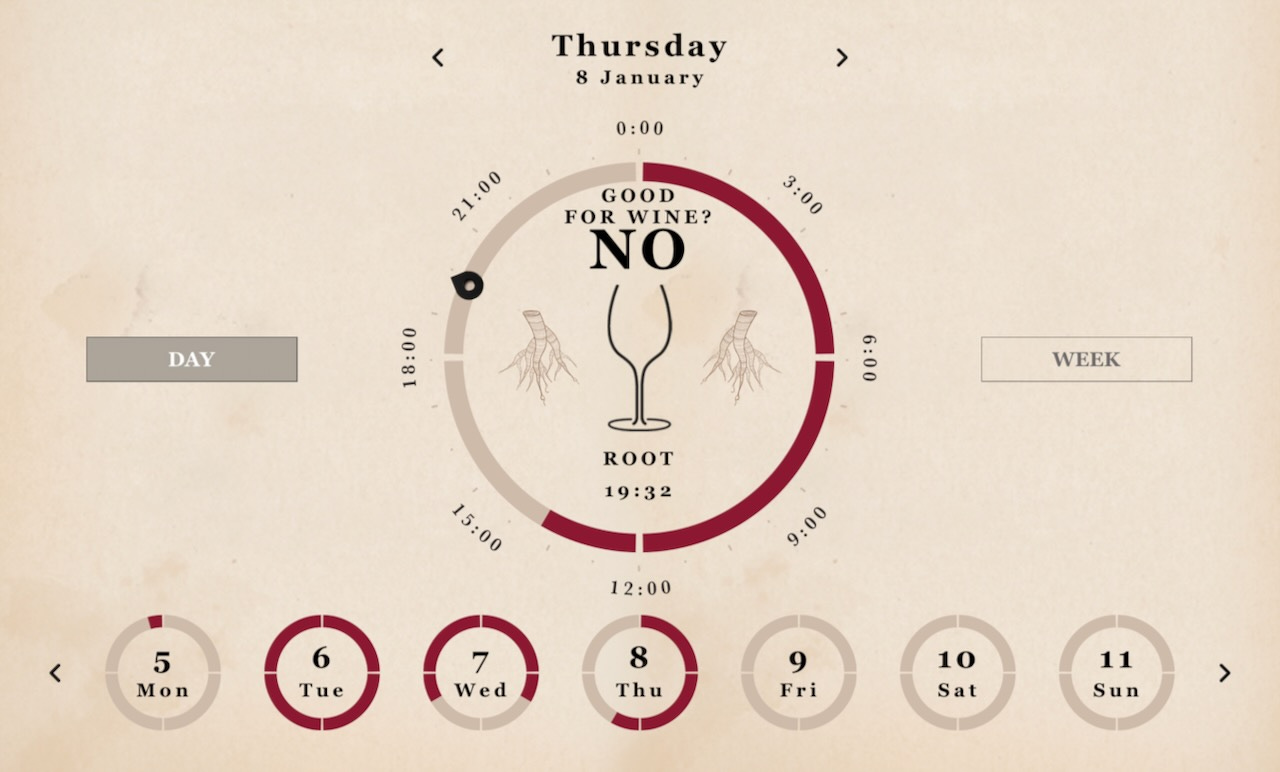
During a recent boozy lunch with wine friends I noticed that the wines somehow felt muted. A friend pulled out the “When Wine Tastes Best” app to check the biodynamic calendar and, oh no, turns out it was a Root Day. Could it really be true that wines taste better on certain days depending on the positions of the moon and planets? Given my rational brain and science-based background I usually struggle with such esoteric astrological wisdom. Yet, this was the third Root Day in two months that a wine didn’t taste great. My curiosity was triggered!
Reading up on biodynamics
First I needed to read up on the biodynamic calendar of Rudolf Steiner and Maria Thun. In short, it assigns each day a “type” (Root, Leaf, Flower, Fruit) depending on the lunar cycle. For example, when the moon passes in front of Earth constellations (Taurus, Virgo, Capricorn) a plant’s energy is said to be directed towards its roots. In contrast, the energy is directed towards bearing fruit when the moon is in front of Fire constellations (Aries, Leo, Sagittarius). Biodynamic growers choose their activity in the vineyard based on the type of day.
Later, Maria Thun hypothesized that since wine is a "living" biological product, it remains sensitive to the same cosmic rhythms that affect the vine it came from. As a consequence, the same wine tastes differently depending on the type of day. Nowadays, many reputable wine makers, wine merchants and wine enthusiasts follow her theory and are convinced that the moon influences the taste of wine.
Fruit and Flower Days are said to be the best times to enjoy our favorite beverage. On Fruit days, wines are most expressive and show their full range of aromas and flavors. Flower Days are great for aromatic whites and elegant reds as they bring out delicate floral notes. In contrast, it’s best to keep the bottle closed on Root Days and Leaf Days. On Root Days, wines tend to be dull with high tannin and muddy, earthy character. Leaf days bring out more vegetal and herbaceous qualities that are often less desirable.
Is there some truth behind these anecdotes and personal experiences? It’s a romantic idea — the wine in your glass is in sync with the rhythm of the distant orbit of the moon — but is it a measurable one? Or is it just “witchcraft” as the Italian Nobel-winning physicist Giorgio Parisi famously stated about biodynamics?1 Let’s look at some data!
The Smoking Gun? A First Look at the Data
To get a first idea if there is a relation between the taste of wine and the biodynamic calendar I checked Cellartracker and looked at the scores for a randomly chosen wine with many reviews, the 2011 R. López de Heredia Rioja Reserva Viña Tondonia.
Here is the average Cellartracker score for each of the four types of day.2
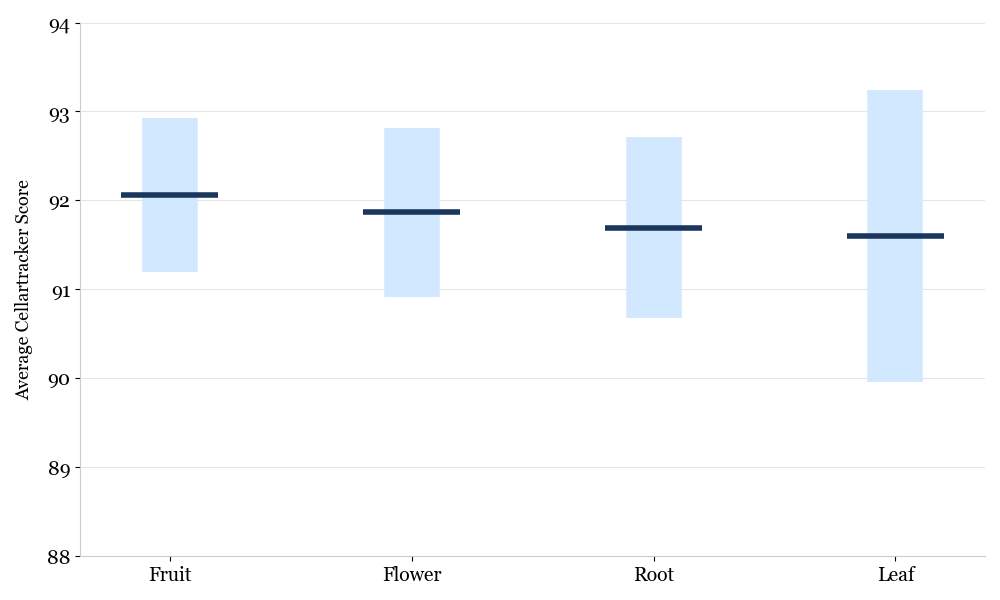
Interesting! At first glance, Figure 1 is a win for the biodynamic calendar. There seems to be a difference in depending on the type of day — exactly what the theory predicts. The wine scores highest on Fruit Days with an average score of 92.1. Flower Days come second with an average score of 91.9. On Root Days and Leaf Days the scores are lower with average scores of 91.7 and 91.6, respectively.
SPOILER ALERT: The “pattern” might just be a mirage. In data science there is always uncertainty involved and it’s still possible that the result is simply due to chance. This uncertainty is visualized in the figure by the blue bars. We can be 95% sure that the true score is somewhere in the indicated range. And because the bars for even the highest and lowest days overlap, we cannot rule out that the apparent “Fruit Day” win is just caused by a lucky roll of the dice and the "real" scores for both days could actually be exactly the same.
Do wines really taste worse on Root Days?
To find out if the pattern is real, we need more than just one wine. We need to shrink those blue bars until there’s nowhere for the truth to hide. So instead of only checking the reviews for the 2011 Tondonia, I collected reviews for more wines - more than 300 to be precise. With more reviews, chance is less likely to play a role and we can get a better idea how the average score of a wine depends on the type of day. For instance, it becomes more likely that the critical tasters drink wine equally often on each type of day. The same argument holds for weather, mood, stress level, food they ate before, etc.
When we combine reviews from different wines, we cannot simply look at averages. Instead, we need to use some statistics and build a so called regression model. But don’t worry, I’ll spare you the equations.3
To find out if the moon actually changes the taste of wine, my model accounts for the “Fancy Wine Effect” and the “Weekend Effect”. We know some wines are simply better than others independent of when they are drunk. By locking in the wine's quality first, my model ensures that a Root Day doesn't look bad just because someone happened to drink a Bourgogne Rouge that day, while a Fruit Day looks good because someone popped a Grand Cru.
We know from psychology, that people generally experience better moods from Friday evening to Sunday afternoon (Ryan, Bernstein, and Brown, 2010). On weekends, we are usually more relaxed, often eating better food, and sharing wine with friends. On Tuesdays, we are often tired or stressed. If people give higher scores on Saturdays simply because they are happy, and Saturday happens to be a "Fruit Day," a simpler model would wrongly credit the moon. My model says, "Adjust for the fact that it's Saturday first—now, is there still a lunar effect?"
Once, we have “vacuumed up” the “Fancy Wine Effect” and the “Weekend Effect”, what’s left over is the pure effect of the biodynamic calendar. If the moon matters, we should see differences in scores even after we’ve accounted for the wine in the bottle and the day of the week.
The verdict? Once we crunch the numbers and put the more than 10,000 reviews through the statistical vacuum, the “Lunar Effect” doesn't just shrink — it effectively disappears.
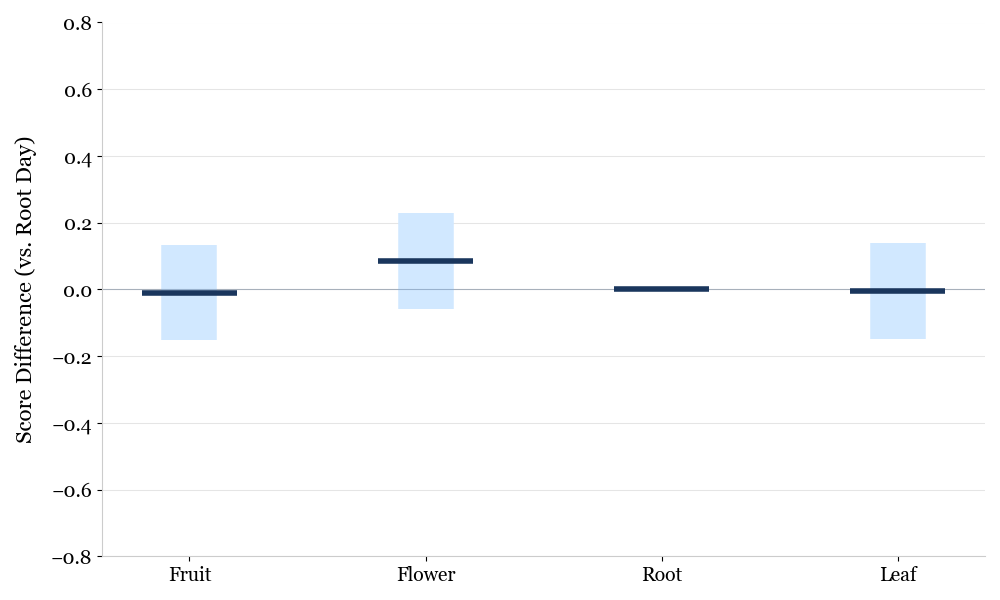
In the figure, Root Day is our “ground floor.” Every other bar shows whether wines scored better or worse than on a Root Day. Note the scale on the left: Even the "highest" performing day, Flower, only improved the score by 0.08 points — an amount so small it would be imperceptible to even the most trained palate. Moreover, every single light-blue bar crosses the zero line. In plain English, this means the difference is so small that it’s statistically indistinguishable from zero. So, even though the average score on Flower Day looks marginally higher, the statistics say that we cannot conclude that it is actually different.4
Conclusion: Permission to pop the cork anytime
Lo and behold the relation between perceived wine quality and the biodynamic calendar seems to belong to the world of esoteric fiction rather than reality.
It’s a fun anecdote that I had three experiences with muted wines on days that in hindsight turned out to be Root Days. But it’s just that: a fun anecdote without any deeper meaning. One (or three) swallows do not make a summer.
What we “know” about wine and the moon is built on what Kahneman (2011) calls the Law of Small Numbers — the cognitive trap of believing that a few vivid tastings represent a universal law . As humans, we are also biologically prone to the Narrative Fallacy (Taleb, 2007). We would rather invent a cosmic story about a “Root Day” than accept the boring reality of random bottle variation or a taster’s bad mood.
But with more than 10,000 data points, we can move past the anecdote. In my statistical analysis I did not find any evidence that people score wines differently depending on the phases of the moon.
So let’s forget the biodynamic calendar and trust our palates instead. Every day is a good day to pop a cork—no lunar permission required.
References
Kahneman, D. (2011). Thinking, Fast and Slow. Farrar, Straus and Giroux.
Ryan, R. M., Bernstein, J. H., & Brown, K. W. (2010). Weekends, Work, and Well-Being: Psychological Need Satisfactions and Day-of-the-Week Effects on Mood, Vitality, and Physical Symptoms. Journal of Social and Clinical Psychology, 29(1), 95–122.
Taleb, N. N. (2007). The Black Swan: The Impact of the Highly Improbable. Random House.
During a debate in the Italian Parliament regarding a law that would have equated biodynamic farming with organic farming, Parisi stated about biodynaimcs: “Frankly, it’s witchcraft.” (“Francamente, è stregoneria.”)
It’s actually not straightforward to obtain these averages: First, I collected the biodynamic calendar from rhythmofnature.net for the years 2021 to 2025. Next, I downloaded the reviews for the same period from cellartracker.com. The biggest challenge is to match a tasting note to the type of day. The type of day can change any time during 24 hours, for instance it can be a Fruit Day in the morning, but a Root Day in the evening. But cellartracker only shows the date and not the time when a review was posted. Therefore, I only use reviews that have been posted during days in which the full 24 hours have the same type. Another issue is that there could be a delay between the time a wine is drunk and the time a review is posted. To mitigate any bias from this, I exclude all reviews that do not have a minimum time of 12 hours since the last change in day type.
If you are not scared of formulas, this is how my regression model looks like:
The dependent variable is the review score i for wine j. The independent variables are a wine specific constant, dummy variables for Sunday to Friday (Saturday is the benchmark) and dummies for Leaf Days, Fruit Days and Flower Days (Root Days are the benchmark).
I also ran a so called F-test to check if all three dummies for Leaf Days, Fruit Days and Flower Days are jointly equal to zero. The p-value is equal 0.5, so we cannot reject the hypothesis that all three coefficients are jointly equal to zero at all common confidence levels.